


Table of Contents
Introduction
Teaching Kids About Hajj can feel hard at first, especially when children are growing up far from Makkah, Muslim neighborhoods, Islamic schools, or large Eid gatherings. Many parents want their children to understand Hajj, but they don’t want the lesson to feel boring, too serious, or full of words children cannot remember.
The good news is this: children don’t need a long lecture to love Hajj. They need stories, activities, family warmth, simple words, and small moments that make Islam feel close to their hearts.
Hajj is one of the Five Pillars of Islam and is a sacred journey to Makkah for Muslims who are physically and financially able to perform it. But for children, we can explain it more simply:
Hajj is a special journey Muslims make to Makkah to worship Allah, make dua, remember the Prophets, and learn patience, sacrifice, and love for Allah.
In this guide, you’ll learn 4 fun and meaningful ways to teach children about Hajj at home.
Why Teaching Children About Hajj Matters
Hajj is not just a journey. It teaches children many important Islamic values.
| Hajj Lesson | What Kids Learn |
| Ihram | Muslims are equal before Allah |
| Tawaf | We worship Allah with love |
| Arafah | Dua is powerful |
| Sacrifice | We give up things for Allah |
| Eid al-Adha | We share, thank Allah, and care for others |
For Muslim families living in non-Muslim countries, these lessons are even more important. Children may see Christmas, Easter, Halloween, or other cultural events around them, but they may not always see Dhul Hijjah or Hajj being celebrated publicly.
That’s why parents can turn the home into a small Islamic learning space. Not a strict classroom. Not a boring lecture. Just a warm place where children hear Islamic stories, ask questions, make crafts, and feel proud of being Muslim.
1. Create a Mini Hajj Journey at Home
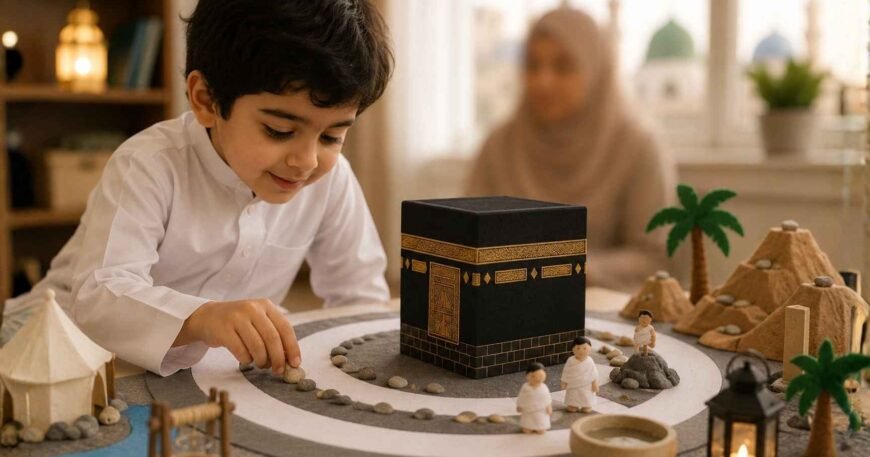
One of the best Hajj activities for kids is a mini Hajj journey at home. Children learn faster when they can move, touch, see, and imagine.
You can create a simple Hajj setup in your living room.
What You Need
| Item | How to Use It |
| Cardboard box | Make a small Kaaba |
| Black paper or cloth | Cover the Kaaba model |
| White towel or scarf | Explain Ihram |
| Sticky notes | Label Hajj stations |
| Paper stones | Explain Muzdalifah and Jamarat simply |
| Dua cards | Help children make dua |
How to Do the Activity
Start with a simple story:
“Today, we are going to learn about Hajj. Real Hajj happens in Makkah, but we are making a small pretend journey at home so we can understand it better.”
Then create stations:
- Ihram Station
Explain that Muslims wear simple clothes and make a clean intention for Allah. - Kaaba Station
Let your child walk slowly around the Kaaba model. Explain Tawaf in simple words. - Arafah Station
Sit together and make dua. Tell your child that Arafah is a very special day of prayer and asking Allah. The Day of Arafah is on the 9th of Dhul Hijjah. - Eid Station
Talk about Eid al-Adha, sharing food, giving charity, and being grateful.
This activity works well because children are not only hearing about Hajj. They are experiencing a child-friendly version of it.
2. Tell the Story of Prophet Ibrahim عليه السلام
Storytelling is one of the strongest ways to teach Islam to children. When parents explain Hajj only as steps, kids may forget. But when parents connect Hajj to a story, children remember.
Many lessons of Hajj are connected to Prophet Ibrahim عليه السلام, Hajar عليها السلام, and Prophet Ismail عليه السلام.
A Child-Friendly Storytelling Style
You can say:
“Long ago, Prophet Ibrahim عليه السلام loved Allah very much. He trusted Allah even when things were difficult. His family also trusted Allah. Hajar عليها السلام showed patience and hope. She searched for water for her baby, and Allah blessed them with Zamzam. Today, when Muslims go for Hajj, they remember these beautiful lessons of faith, trust, and obedience.”
Keep it gentle. Don’t make the story scary for younger children. Focus on:
- trust in Allah
- patience during hard times
- making dua
- Allah’s mercy
- family faith
- sacrifice for Allah
Questions to Ask After the Story
| Question | Purpose |
| What did Prophet Ibrahim عليه السلام teach us? | Builds Islamic understanding |
| What can we do when we feel worried? | Connects story to real life |
| Why should we trust Allah? | Builds faith |
| What good deed can we do today? | Turns learning into action |
Stories help children connect the rituals of Hajj with real lessons they can use every day, such as trusting Allah, being patient, making dua, and showing kindness.
3. Make a Dhul Hijjah Good Deeds Chart
Children love charts. They enjoy stickers, checkmarks, and small daily goals. A Dhul Hijjah good deeds chart is a simple way to teach them that the days before Eid al-Adha are special.
The first days of Dhul Hijjah are known as blessed days for worship and good deeds. Islamic Relief notes that righteous deeds during these days hold special importance.
10-Day Dhul Hijjah Activity Chart
| Day | Good Deed for Kids |
| Day 1 | Say Alhamdulillah 10 times |
| Day 2 | Help parents without being asked |
| Day 3 | Give small charity |
| Day 4 | Learn one Hajj word |
| Day 5 | Make dua for family |
| Day 6 | Listen to Quran |
| Day 7 | Share a toy or snack |
| Day 8 | Learn about Arafah |
| Day 9 | Make a dua list |
| Day 10 | Celebrate Eid with gratitude |
This activity teaches children that Islam is not only something we read about. Islam is something we live.
You can place the chart on the fridge or bedroom wall. Every day, let your child tick one box. At the end, celebrate with a small Eid gift, a family story night, or a special dessert.
4. Use Hajj Role Play and Family Discussion
Role play is perfect for younger children. It makes learning active and fun.
You can say:
“Let’s pretend we are learning about the Hajj journey. We are not performing real Hajj, but we are learning what Muslims do and why it matters.”
Simple Role Play Ideas
| Hajj Concept | Child-Friendly Activity |
| Ihram | Wear simple white clothing |
| Tawaf | Walk around a Kaaba craft |
| Talbiyah | Repeat simple phrases with parents |
| Arafah | Sit quietly and make dua |
| Eid al-Adha | Talk about sharing and sacrifice |
After the activity, sit as a family and ask:
“What is one thing you want to ask Allah for?”
This small question can become a beautiful parenting moment. Children learn that dua is not complicated. They can speak to Allah about their hopes, fears, family, school, and feelings.
Simple Hajj Words Kids Should Learn
| Word | Simple Meaning |
| Hajj | A special journey to Makkah |
| Kaaba | The sacred house Muslims face in salah |
| Ihram | A special state for Hajj |
| Tawaf | Walking around the Kaaba |
| Arafah | A special day of dua |
| Zamzam | Blessed water in Makkah |
| Eid al-Adha | A Muslim celebration after Hajj |
How Quran Learning Helps Children Understand Hajj
Children understand Hajj better when they already have a connection with Quran, salah, duas, Islamic stories, and the names of the Prophets.
That is where consistent Islamic learning helps.
At Quran in Universe, we help Muslim children build a loving connection with Quran and Islamic values through online Quran classes designed for families living anywhere in the world. When children learn Quran regularly, they don’t see Hajj as a strange or distant topic. They see it as part of their deen.
This is especially helpful for families living outside Muslim-majority countries, where children may not always have Islamic learning around them every day.
Common Mistakes Parents Should Avoid
| Mistake | Better Approach |
| Explaining too much at once | Keep it simple |
| Using scary details | Focus on love and trust in Allah |
| Making it only a lecture | Add crafts and stories |
| Expecting perfect answers | Let children learn slowly |
| Ignoring questions | Welcome curiosity |
Remember, the goal is not to make children memorize every step of Hajj in one day. The goal is to help them love Islam.
Conclusion
Teaching Kids About Hajj becomes easier when parents use stories, crafts, role play, and simple family activities. Children do not need perfect explanations. They need warm memories, loving guidance, and regular Islamic learning.
Start with a small Kaaba craft. Tell the story of Prophet Ibrahim عليه السلام. Make a Dhul Hijjah chart. Sit together and make dua.
Little by little, your child will begin to understand that Hajj is not only a journey to Makkah. It is a journey of faith, patience, love, sacrifice, and closeness to Allah.
For Muslim families raising children in today’s busy world, these small lessons can build a strong Islamic identity, one loving activity at a time.
Are you preparing for your own Hajj journey this year? While you help your children learn these beautiful lessons, do not forget your own spiritual preparation. If you feel anxious about your pronunciation, check how to correct your Tajweed and Duas privately online to build your confidence before your flight.
Claim your free trial Quran class today and watch your child’s love for the Quran blossom.
Frequently Asked Questions (FAQs)
1. How do I explain Hajj to a child simply?
Say: “Hajj is a special journey Muslims make to Makkah to worship Allah, make dua, and remember important lessons from the Prophets.”
2. What age should kids learn about Hajj?
Children can start learning about Hajj around ages 3–4 through pictures, stories, and crafts. Older children can learn the steps in more detail.
3. What are easy Hajj activities for kids?
Easy activities include making a Kaaba craft, creating a mini Hajj journey at home, telling the story of Prophet Ibrahim عليه السلام, making a Dhul Hijjah chart, and doing Hajj role play.
4. Should children memorize all the steps of Hajj?
Young children do not need to memorize every step. It is better to teach the meaning first. Details can come later.
5. How can parents make Hajj exciting for kids?
Use storytelling, crafts, role play, family discussions, maps, dua cards, and good deed charts.
6. Can online Quran classes help children learn about Hajj?
Yes. Online Quran classes can help children learn Quran, Islamic stories, duas, and basic Islamic beliefs, which makes Hajj easier to understand.
Related Posts