


Table of Contents
Preparing for Hajj is one of the most profound spiritual milestones in a Muslim’s life. After years of intention, planning, and saving, securing your place for this sacred journey brings immense joy. However, beneath the excitement, many adults experience a quiet sense of anxiety regarding their Arabic pronunciation.
If you have not practiced your Tajweed (the rules of Quranic recitation) in years, the fear of mispronouncing the Talbiyah or making mistakes in your personal Duas while standing on the plains of Arafat is entirely normal. For busy professionals and parents living in London, New York, Toronto, or Sydney, finding the time to attend a local learning center before departure can be incredibly difficult.
The good news is that perfecting your pronunciation does not require rearranging your entire life. Whether you are preparing for your flight from the USA, the UK, Australia, or navigating a busy expat schedule in Qatar or UAE, you can refine your Tajweed privately, efficiently, and effectively from the comfort of your home.
This will help you identify common mistakes, offer practical at-home practice methods, and show you how to build ultimate confidence before your journey begins.
1. The Spiritual Importance of Clear Pronunciation
During Hajj, your voice is constantly engaged in worship. From the moment you enter the state of Ihram, the words you speak carry profound weight. The Arabic language is incredibly precise; a slight change in an articulation point (Makharij) or the length of a vowel (Harakat) can significantly alter the meaning of a word.
When we strive to pronounce our Duas correctly, we are not just following rules; we are showing deep respect for the words of Allah and the traditions of our final and last Prophet Muhammad (peace be upon him). Correcting your Tajweed is an act of worship in itself. It brings a profound sense of peace and presence (Khushu) to your Hajj experience, knowing you are calling upon your Creator exactly as intended.
2. Common Tajweed Challenges for English Speakers During Hajj
Before you can correct your recitation, it helps to know exactly what to look for. English speakers often face specific phonetic challenges when reciting Arabic. During Hajj, the most frequently repeated phrases are often the ones where these subtle mistakes occur.
| The Mistake | Where It Happens | How to Correct It |
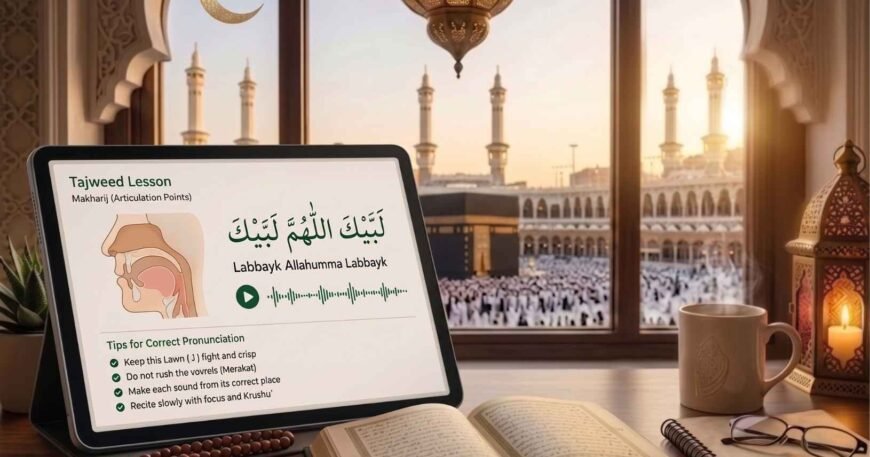
| Mixing Heavy & Light Letters | The Talbiyah (Labbayk) | The Arabic letter “Laam” (L) can be heavy or light. Practice keeping the “L” in Labbayk light and crisp at the front of the mouth, rather than deep in the throat. |
| Confusing Similar Sounds | General Supplications | Differentiate between the sharp, breathy ‘Ha’ (ح) and the softer, chest-based ‘ha’ (هـ). Mixing these changes the translation of your Dua completely. |
| Rushing the Harakat (Vowels) | Tawaf Prayers | Anxiety causes us to speak faster. Slow down and ensure every short vowel (Fatha, Kasra, Damma) gets its full, precise, and equal timing. |
| Misplacing the ‘Ayn’ (ع) | Seeking Forgiveness | The ‘Ayn’ requires a distinct squeeze in the middle of the throat. Do not confuse it with a standard “A” or Hamza (ء), which is a simple stop of sound. |
3. Why Busy Adults Need a Flexible Learning Approach
Local mosques and traditional community centers do wonderful, foundational work for Islamic education. They are the heart of the community. However, their structured evening or weekend schedules are often designed for young children or full-time students.
If you are managing a demanding career in Europe or running a household in Canada, committing to a fixed class multiple times a week is often impractical. Furthermore, many adults feel hesitant to join group settings if they are starting from the basics, preferring a more private environment to practice making these new, sometimes unfamiliar phonetic sounds.
Adults require a learning approach that is logical, private, and highly adaptable to Western lifestyles. You need a space where you can ask specific questions about your Hajj Duas without feeling rushed or overwhelmed by a rigid, one-size-fits-all syllabus.
Need quick feedback? Click here to connect on WhatsApp for a Free Pronunciation Audit
4. Four DIY Methods to Polish Your Duas at Home
You can begin preparing your heart and your tongue right now. Here are four highly effective, practical methods you can use at home using just your smartphone:
- Method 1: The “Voice Memo” Audio Audit: We often cannot hear our own mistakes while speaking because our brain anticipates what we meant to say. Open the voice recorder app on your phone. Record yourself reciting the Talbiyah or your favorite Duas. Play it back while following along with the written Arabic text. Listening to a recording instantly highlights where you might be struggling with a specific articulation point.
- Method 2: The Three-Second Chunking Strategy: Find a trusted audio clip of a recognized Qari (reciter) on a reliable Islamic app. Do not try to listen and repeat whole paragraphs at once. Instead, listen to just three seconds of audio. Pause the track, and repeat that short segment aloud. This isolates difficult letters and helps train your muscle memory without overwhelming your mind.
- Method 3: The Meaning-First Approach: Pronunciation naturally improves when emotion and understanding are attached to the words. Spend time reading the English translation of the Duas you plan to make at Mount Arafat. When you understand the deep, emotional plea behind the Arabic words, your pacing will naturally slow down, which drastically reduces pronunciation errors.
- Method 4: Practice Tarteel (Measured Recitation): Allah commands in the Quran to recite with Tarteel, a slow, measured, and rhythmic tone. Before your trip, resist the urge to memorize quickly. Focus on reciting slowly. Slower recitation gives your brain the fraction of a second it needs to correctly place your tongue for the next letter.
5. The Advantage of Private, Judgment-Free Feedback
While self-recording and listening are excellent starting points, the most effective way to gain absolute confidence before your pilgrimage is to have a knowledgeable mentor listen to you. A trained ear can gently correct a mispronounced letter that you might not have noticed.
Today, you do not need to wait for a local class to open. Online learning allows you to connect privately with a dedicated tutor from your own home. A modern, adult-focused approach offers significant advantages for those preparing for Hajj:
- Complete Privacy: One-on-one sessions mean your practice is between you and your teacher. It is a dignified, safe space to ask questions, make mistakes, and learn at your own pace without any shame or embarrassment.
- Clear Communication: Working with a tutor who speaks fluent English ensures that complex Tajweed rules are explained logically and clearly, preventing any frustrating language barriers.
- Global, Flexible Scheduling: Whether you are coordinating around EST, GMT, or AEST, you can easily schedule a focused session that fits perfectly into your lunch break or evening routine.
6. Prepare Your Heart, Perfect Your Words
Hajj is fundamentally about your intention and your heart’s devotion to Allah. The effort you put into correcting your words before you travel is a beautiful reflection of your respect for this once-in-a-lifetime journey.
If you feel that private guidance would help you perfect your Talbiyah and Duas before your trip, we want to help you take the first step. Send us a 30-second Voice Memo of your Talbiyah on WhatsApp, and our expert will give you a free, private pronunciation audit. From there, our online Quran tutors for adults offer flexible, judgment-free sessions tailored entirely to your schedule and goals.
(Are you traveling with family? While you focus on your own spiritual preparation, ensure your children understand the beauty of the journey too by trying these fun Hajj activities for kids at home.)
Claim your free trial Quran class today and watch your child’s love for the Quran blossom.
Frequently Asked Questions (FAQs)
Can I learn proper Tajweed online just a few months before Hajj?
Absolutely. While mastering the entire Quran takes time, a private tutor can help you focus specifically on the key Duas, the Talbiyah, and short Surahs you will use daily during your pilgrimage, ensuring you are prepared in a short timeframe.
Is it okay to read Duas from a book or phone during Hajj if my Arabic is weak?
Yes, it is completely permissible and very common to read from a Dua book or a phone during Hajj and Umrah. The most important aspect is your sincerity. However, practicing the pronunciation of those written Duas beforehand will give you much more peace of mind.
What if I make a pronunciation mistake during Tawaf?
Allah is the Most Merciful and judges us by our intentions. If you make an honest mistake while trying your best, you are rewarded for your effort. Preparing beforehand simply helps you focus more on the spiritual experience rather than worrying about the words.
What are the most common pronunciation mistakes made during Hajj?
Pilgrims often struggle with three main areas:
1. Heavy vs. Light letters: Specifically the ‘L’ in Labbayk.
2. Similar sounding phonetics: Confusing the deep ‘Ha’ (ح) with the soft ‘ha’ (هـ).
3. Vowel timing (Harakat): Rushing through supplications during high-stress moments like Tawaf.
Related Posts