



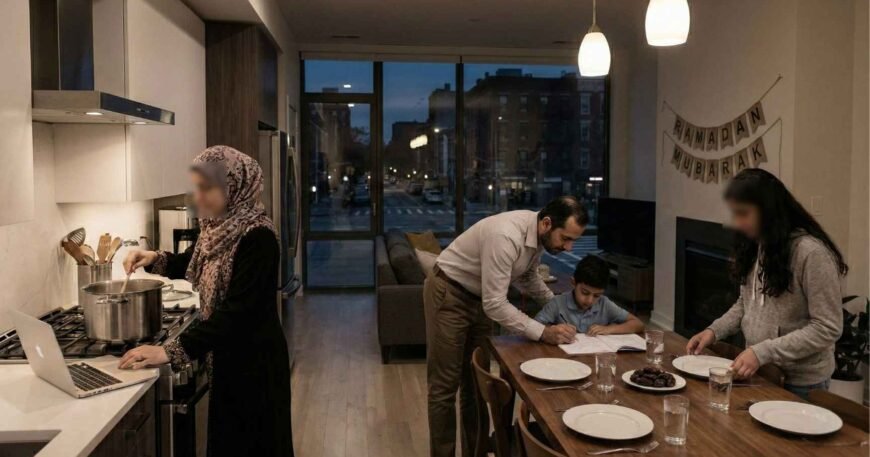
When Ramadan arrives, it brings a profound sense of hope and spiritual renewal. We all plan to pray more, read more of the Quran, and be fully present with our families. But for Muslim families living in the USA, UK, Canada, or Australia, establishing a realistic Ramadan routine for Muslim families can feel like an uphill battle.
In the West, real life does not pause for Ramadan. Work deadlines continue, office hours remain the same, and the morning School Runs still happen. Whether you are dealing with Daylight Savings Time shifting the sunset, navigating long Summer Fasting days, or managing timezone differences across EST/GMT for work, balancing school and fasting in the West requires serious strategy.
You are not alone if you feel the heavy guilt of trying to be the perfect parent, the perfect employee, and the perfect Muslim all at once. The truth is, Ramadan was meant to soften life, not compete with it.
This guide is designed for busy professionals and parents. We will walk you through a practical, step-by-step Ramadan schedule for working parents so you can balance Deen and Dunya without hitting burnout.
1. The “Power Suhoor”: Starting the Day with Barakah
It is incredibly tempting to grab a quick glass of water and go back to sleep, but skipping this pre-dawn meal will leave you drained. Suhoor is not just about physical fuel; it is the foundation of the day’s Barakah (blessings).
For families, this early morning gathering is a prime opportunity for Tarbiyah (character building). Instead of rushing in silence, use this quiet time for family bonding. Teach your children the Sunnah of the pre-dawn meal and start the day with a shared intention.
Actionable Suhoor Meal Prep Tips for Busy Parents:
- Focus on Sustained Energy: Fill up on foods that will keep you energized, like oats, protein, and water. Consider preparing an oatmeal smoothie with dates, eggs, and yogurt to balance carbs with protein.
- Prep the Night Before: The secret to a stress-free morning is Suhoor Meal Prep. Batch-cook over the weekend or lay out the bowls, dates, and water glasses before you go to sleep.
- Avoid Sugar: Try not to load up on sugar-rich foods or drinks, as they lead to mid-morning energy crashes.

2. Managing School and Fasting for Muslim Kids
Figuring out how to manage school during Ramadan is one of the biggest sources of anxiety for parents in the West. Children spend a massive portion of their day in a non-Muslim environment, making them susceptible to fatigue and feelings of isolation.
Advocating for Your Child at School:
- Communicate Early: A quick heads-up to your child’s teachers goes a long way. Send a polite email explaining that your child is fasting. Most teachers are understanding and fascinated by this sacred time.
- Navigating PE (Physical Education) & Lunch Break: Ask if your child can have modifications during PE, such as focusing on stretching or light skill-based activities instead of high-intensity drills. During the Lunch Break, see if the school allows fasting students to sit in the library for quiet reflection or reading, rather than the loud cafeteria.
To make this easier, here is a quick-action guide you can use to structure your child’s accommodations:
| School Scenario | Parent Action / Accommodation Request | Why It Helps Your Fasting Child |
| Lunch Break | Request access to the school library or a quiet classroom. | Avoids the temptation of watching others eat and provides a mental rest. |
| PE (Physical Education) | Ask the teacher for light stretching, refereeing, or theory work. | Prevents severe dehydration and preserves their physical energy. |
| Morning Classes | Remind them to tackle harder subjects or tests before noon. | Leverages their peak energy levels right after their morning Suhoor. |
| The School Run | Pick them up promptly and play calming Quran or Dhikr in the car. | Reduces sensory overload and transitions them smoothly into resting at home. |
Handling the After-School “Crash”: When kids walk through the door after school, they are often exhausted and “hangry” (hungry and angry). Instead of demanding they immediately start homework, let them rest. A short 20 to 30-minute power nap after school, ideally before Asr prayer, can restore energy without disrupting their nighttime sleep.
3. Navigating Office Hours for Busy Professionals
For working adults, productivity tips for fasting at work are essential to survive the corporate 9-to-5. When your energy dips in the afternoon, it can be hard to maintain focus on complex tasks.
Strategies for the Fasting Professional:
- Time-Boxing & Priority Scheduling: Structure your day around your energy levels. Tackle complex analytical work right after Suhoor or early in the morning when your brain is sharpest. Save lighter tasks, responding to emails, or organizing files for the late afternoon when fatigue sets in. “Time boxing helps me visualize my daily tasks and know exactly how much time I need to give to each one,” notes one professional.
- Communicating with a Non-Muslim Boss: Discuss your plans for Ramadan with your employer in advance. Politely explain your religious obligations and request any necessary adjustments, such as flexible hours or a slightly shifted schedule. Many companies are now highly accommodating to diversity and wellness needs.
- Micro-Breaks: Take short breaks to step away from your screen. Use your typical lunch hour to rest your eyes, perform Dhuhr prayer, or engage in quiet Dhikr.
4. The Pre-Iftar “Golden Hour” (Keeping Kids Engaged Safely)
The Pain Point: The hour right before Iftar Time is notoriously chaotic. Parents are exhausted from a long day of work and are busy in the kitchen trying to get food on the table. Meanwhile, kids are bored, tired, and counting down the minutes. Out of desperation, many parents hand over a tablet, leading to worries about unmonitored screen time and online safety. Alternatively, forcing them into a rigid, boring rote-memorization class only makes them want to run away.
The Solution:
This “Golden Hour” is the perfect time to schedule flexible online Quran classes for kids. Instead of unregulated YouTube videos, you can provide them with a safe, enriching environment right from your living room.
At Quran in Universe, we solve this daily struggle. We are not a strict Madrasah; we provide Friendly Mentors who are rigorously background-checked for your peace of mind. Here is how we transform the pre-Iftar chaos into a time of joy:
- Gamified Learning: We cure boredom by making the Quran fun. Our interactive lessons ensure kids stay focused and actually look forward to their classes.
- Cutting-Edge Tech: Using Zoom, Screen Sharing, and an Interactive Whiteboard, our teachers create a dynamic visual environment that holds a child’s attention.
- Native English Tutors: There is no language barrier here. Our instructors have native-level English communication, allowing them to logically explain concepts to Western-raised children.
- Focus on Character: We go beyond rote memorization. Our mentors weave in lessons on Adab (Manners) and Sabr (Patience), turning a standard class into a holistic Tarbiyah experience.
For adults and university students seeking the same quality, we offer complete privacy, flexible scheduling, and logical teaching methods tailored to mature minds.

5. Evening Routine: Simple Iftars & Meaningful Ibadah
When the sun finally sets, it is time to recharge. However, the way you manage your evening dictates how successful your next day will be.
Keep It Simple: Do not gorge during Iftar, or you will find yourself drifting into a food coma. Break your fast with dates and water, following the Sunnah, before eating a balanced, reasonably-sized meal. Remember, Ramadan is about worship and reflection, not extravagant feasts. Simplifying your cooking saves you precious energy.
The 10-Minute Family Halaqa: Before the rush of nighttime prayers, dedicate just 10 minutes to a Family Halaqa. Gather around the table and share stories from your day. Discuss Islamic values like Adab and Sabr, or read a short story about the Prophets. Consistent, small moments of connection carry immense Barakah.
Sleep Management & Taraweeh:
Balancing the Taraweeh Prayer with early morning alarms is the ultimate test. If you are exhausted, prioritize the obligatory prayers. It is better to pray fewer units of Taraweeh with sincerity and focus than to force yourself to stay awake and resent the lack of sleep the next day at work. As we approach the last ten nights seeking Laylatul Qadr, strategic power naps become even more critical to avoid burnout.
6. Sample Daily Ramadan Schedule for the West
Having a visual structure helps keep the whole household aligned. Below is a highly practical timeline tailored for families navigating typical Western routines.
| Time | Activity | Focus / Actionable Tip |
| 4:30 AM | Power Suhoor | Eat complex carbs & proteins. Make intention (Niyyah) together. |
| 5:15 AM | Fajr & Morning Dhikr | Pray as a family. Read 2-4 pages of the Quran before the day starts. |
| 7:30 AM | School Runs & Commute | Listen to an Islamic podcast or recite Dhikr in the car/train. |
| 8:30 AM | Office Hours / School | Tackle the hardest work tasks early. Kids manage energy during PE. |
| 1:00 PM | Lunch Break / Dhuhr | Step away from the desk. Pray Dhuhr and take a 15-minute mental rest. |
| 4:00 PM | After-School Rest | Kids take a 20-minute power nap before Asr to avoid the “hangry” crash. |
| 5:30 PM | The “Golden Hour” | Parents prep food/rest. Kids attend Quran in Universe online classes. |
| 7:00 PM | Family Halaqa | 10-minute discussion on Adab and Sabr while waiting for the Adhan. |
| 7:30 PM | Iftar Time & Maghrib | Break fast simply with dates. Pray Maghrib before eating the main meal. |
| 9:30 PM | Isha & Taraweeh Prayer | Attend the local Masjid or pray at home. Focus on quality over quantity. |
| 11:00 PM | Sleep | Wind down quickly to ensure enough rest before the next Suhoor alarm. |
(Note: Times are examples and will vary based on your local EST/GMT timezone and the time of year).
Conclusion & Next Steps
Balancing a demanding job, children’s schooling, and your spiritual goals is undeniably hard, but it is deeply rewarding. Remember that Allah does not ask for burnout; He asks for sincerity. A prayer performed with presence is better than many rushed out of guilt. Consistency is far more important than perfection.
If you are struggling to fit quality Islamic education into your family’s busy routine, let us help share the load.
Would you like to reclaim your pre-Iftar peace of mind? Let our Friendly Mentors take over your child’s Quran education with engaging, safe, and interactive lessons. Book your Free Trial (No Credit Card required) with Quran in Universe today and experience gamified learning that perfectly fits your Western lifestyle!
Frequently Asked Questions (FAQs)
How do I handle my child’s PE classes and lunch breaks while they are fasting at a Western school?
The best approach is proactive communication. Send a polite email to the school requesting reasonable accommodations for PE (Physical Education), such as allowing your child to do light stretching, refereeing, or theory work instead of high-intensity cardio. For the Lunch Break, ask if your child can sit in the library or a quiet classroom so they can rest away from the sights and smells of the busy cafeteria.
How can I maintain productivity during office hours while fasting in the West?
You can maintain productivity by time-blocking your day based on your energy levels. Schedule your most intensive, brain-heavy tasks for the early morning right after your Power Suhoor, when your focus is at its peak. Save lighter administrative tasks or meetings for the mid-afternoon energy slump. Additionally, consider speaking to your non-Muslim boss about adjusting your office hours slightly or allowing remote work to accommodate your schedule.
How can I keep my kids safely engaged with Islamic learning while I am busy preparing Iftar?
The most effective and safe method is to utilize the pre-Iftar “Golden Hour” with flexible online Quran classes. Instead of relying on unmonitored screen time, you can enroll them in a program like Quran in Universe. Our background-checked, native English-speaking Friendly Mentors use Gamified Learning and an Interactive Whiteboard to keep children excited about Tarbiyah and Quran, giving you peace of mind while you prep for Iftar Time.
How do working parents balance late Taraweeh prayers with early school runs and work?
The key is prioritizing quality over quantity and utilizing power naps. If attending the local Masjid for a full Taraweeh Prayer pushes your bedtime too late for your early morning school runs, it is perfectly acceptable to pray fewer units at home. Incorporate a 20-minute power nap after work, keep your Iftar meals light, and ensure you get enough sleep to wake up refreshed for Suhoor.
How does Daylight Savings Time affect our family’s Ramadan schedule in the US and UK?
Daylight Savings Time shifts the clocks forward, which pushes sunset (and Iftar time) an hour later into the evening. Depending on your specific EST/GMT timezone, this can create longer fasting windows and later bedtimes. To adapt smoothly, ensure your Suhoor meal prep includes slow-digesting, high-protein foods, and gradually adjust your children’s sleep schedules by 15-minute increments the week before the time change occurs.
Related Posts