


Table of Contents
As a Muslim parent raising a child in a non-Muslim majority country, there is a quiet worry that often keeps you up at night. You watch your little one play, and you wonder: Will they grow up with a deep love for Islam? Will they connect with the Book of Allah when surrounded by a culture so different from our Deen? When you live abroad, preserving your child’s Islamic identity feels like a heavy responsibility. Without a local madrasa down the street or an extended family to help teach the Arabic alphabet, it is entirely normal to feel overwhelmed. You want the best for your child, but finding a safe, engaging, and qualified teacher for a very young child is difficult.
This is exactly why online Quran classes for kids aged 3 to 7 have become a lifeline for Muslim diaspora families.
If you are wondering how to start Quran for young kids, whether your toddler is ready, or how screen time impacts early childhood Islamic education, you are in the right place. In this complete guide, we will walk you through everything you need to know to give your child a joyful, pressure-free introduction to the Quran.
What Age Should Kids Start Learning Quran Online?
One of the most common questions parents ask is about the best age to start Quran online. The truth is, there is no magic number. Every child is different, and child readiness for Quran depends heavily on their individual development. However, breaking down the learning journey by age group can help set realistic expectations.
Age 3–4: First Steps
Can a 3-year-old really learn online? Yes, but the approach must be entirely play-based. Quran classes for toddlers online are not about rigid memorization or sitting perfectly still. At ages 3 and 4, children have sponge-like memories but very short attention spans.
- The Focus: Auditory learning. They will listen to their teacher, mimic sounds, and learn through repetition.
- Expectation: Your 4-year-old may not sit still for 30 minutes, and that is completely normal. An experienced early childhood educator will use songs, visual cues, and interactive screen sharing to keep them engaged in 15 to 20-minute bursts.
Age 5–6: Building Foundation
At kindergarten age, children experience a massive leap in cognitive development and fine motor skills. This is the ideal window for Quran learning for kids aged 3 4 5 6 7.
- The Focus: Visual recognition. This is when online Quran for young children transitions into recognizing the Arabic alphabet and understanding basic letter connections.
- Expectation: They are ready for structured Noorani Qaida lessons. They can follow simple instructions on a digital whiteboard and begin reciting short verses independently.
Age 7: Structured Learning Begins
By age 7, the Prophet Muhammad (PBUH) advised us to teach our children to pray, marking a shift toward structured discipline.
- The Focus: Reading fluency and basic Tajweed. Seven-year-olds can handle standard 30 to 45-minute lessons.
- Expectation: They are ready for proper Nazra online (reading by looking) and can begin a gentle Hifz for young children routine.
Why Online Quran Classes Work So Well for Young Kids
Many parents naturally worry about screen time and learning. But it is crucial to understand the difference between passive screen time (like watching YouTube cartoons) and active, interactive screen time.
- Undivided 1-on-1 Attention: In a traditional classroom, a shy 5-year-old might easily get distracted or ignored. In 1-on-1 online Quran classes for kids aged 3 to 7, the tutor’s eyes are only on your child, keeping them completely engaged.
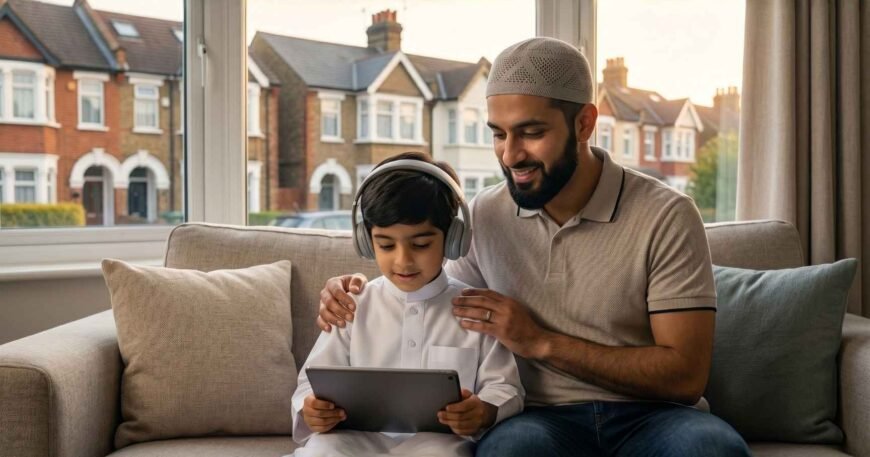
- A Safe Online Environment: You do not need to worry about the long commute to a weekend Islamic school or who your child is interacting with. They learn from the safety and comfort of your living room, where you can hear every word.
- Maximum Flexibility: Busy family schedules often clash with rigid madrasa timings. Flexible online Quran classes for kids allow you to choose times that suit your child’s peak energy levels, whether that is right after breakfast or before a nap.
What Will My Child Learn? (Age-by-Age Breakdown)
When enrolling in beginner Quran classes for children, parents often wonder what the actual syllabus looks like for early learners. Here is a breakdown of a developmentally appropriate curriculum.
Starting with Noorani Qaida
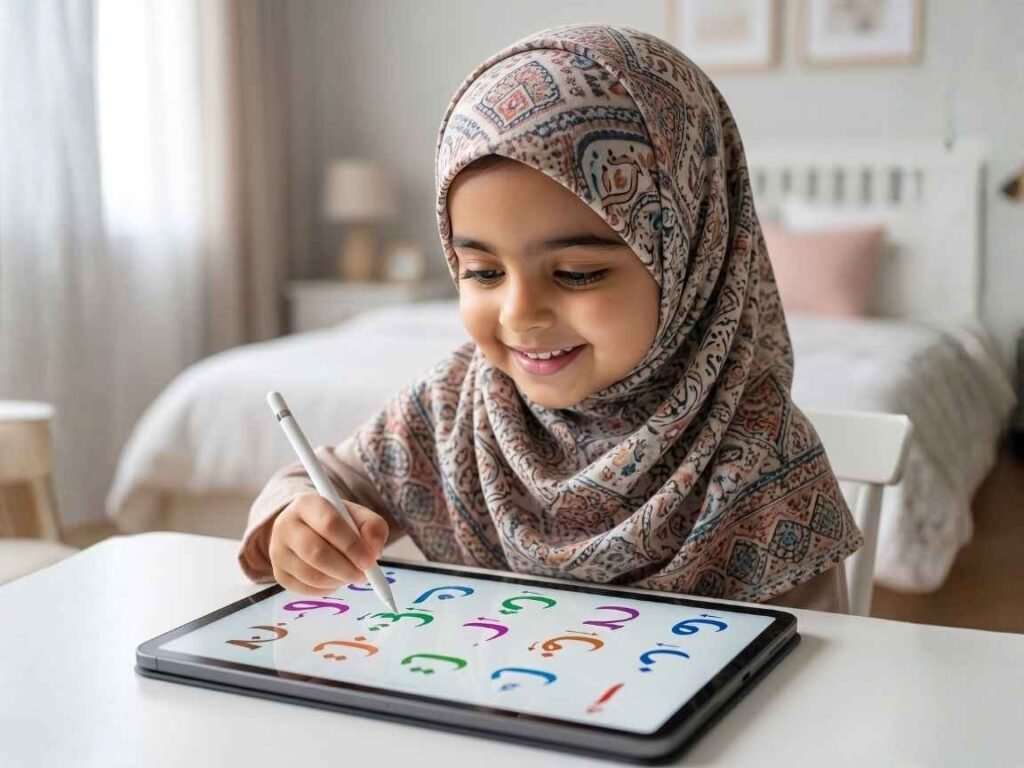
For toddlers and preschoolers, everything begins here. Noorani Qaida for beginners is the foundational building block of Quranic reading. A child-specialist tutor will not rush this process. They will use colorful digital whiteboards to turn learning into a fun, interactive game rather than a stressful chore.
Arabic Alphabet and Pronunciation
Because many diaspora children face a language barrier with Arabic, mastering the Arabic alphabet for kids requires a specific focus on Makharij (correct articulation points). A certified Quran teacher will use visual aids to show your child exactly where to place their tongue and lips to produce the correct sounds, ensuring bad habits do not form early on.
Short Surahs and Daily Duas
Before a child can read fluently, they can memorize through listening. Tutors focus heavily on short Surahs memorization (like Surah Al-Kawthar and Surah Al-Asr). They will gently teach Surah Al-Fatiha for kids and Surah Al-Ikhlas for beginners, the Surahs they will need for their daily prayers. Alongside this, teachers weave in daily duas for kids (like the dua before sleeping or eating), instilling deep Islamic values and Akhlaq into their daily routine.
Basic Tajweed for Kids
It is a misconception that Tajweed is only for older students. Tajweed basics for children can be introduced as early as age 5. Instead of teaching complex theoretical rules, trained Quran teacher will simply model the correct recitation, teaching the child to elongate certain vowels or nasalize specific letters purely through imitation.
How to Choose the Right Online Quran Teacher for a 3–7 Year Old
Teaching a 4-year-old requires an entirely different skill set than teaching an adult. When searching for an online Quran tutor for young kids, qualifications matter, but personality matters just as much.
- Look for a Child-Specialist: An Ijazah certified tutor is excellent, but they must also possess the patience to redirect a distracted kindergartener gently.
- Gender Preferences: Many families raising daughters prefer a female Quran teacher for girls to build a nurturing, motherly bond and provide a comfortable role model for Islamic behavior.
- Engaging Methodology: The best teachers use interactive Quran lessons via Zoom, utilizing screen sharing, digital stickers, and praise to keep the attention span of young children focused on the Deen.
- Communication: A great online Quran academy will always provide regular progress reports for parents so you are never left guessing about your child’s development.
A Note for Muslim Parents in USA, UK, Canada, Australia, UAE, Qatar, Germany, Norway & New Zealand
Raising an Islamic household in the Western diaspora or as an expat family comes with unique logistical hurdles. We understand the shared struggle.
Families seeking online Quran classes for kids in USA often struggle to find tutors who align with diverse American time zones (EST to PST) while balancing public school homework. Across the ocean, parents looking for online Quran classes for kids UK need high-quality early Islamic education that fits seamlessly into their early evening routines.
The harsh winters make commuting to local mosques difficult, which is why online Quran classes for kids Canada and online Quran classes for kids Norway have become absolute necessities. Similarly, parents seeking online Quran classes for kids Australia and online Quran classes New Zealand often face massive timezone gaps when trying to hire qualified tutors from the Middle East.
Even in Muslim countries, expat families desire highly personalized 1-on-1 attention, driving the demand for online Quran classes UAE, online Quran classes Qatar, and options across Saudi Arabia. And for those in mainland Europe, such as families searching for online Quran classes Germany, finding a tutor who can bridge the cultural and language gap is paramount.
No matter where you live, you are part of a global community of Muslim parents abroad striving for the same goal: protecting your child’s Iman.
Tips to Make Quran Learning Fun and Consistent for Young Kids
To ensure your child’s online Quran classes for kids aged 3 to 7 are a success, parental involvement is key. Here is how you can support your young Muslim children at home:
- Create a “Quran Corner”: Dedicate a specific, quiet spot in your home for their interactive Quran lessons. Add a cozy rug, some Islamic books, and good lighting.
- Keep it Short and Sweet: Do not force a 4-year-old to sit for an hour. 20 to 30 minutes of focused, happy learning is far better than 60 minutes of tears.
- Celebrate Small Wins: Did they finally pronounce the letter ‘Kha’ correctly? Did they memorize Surah Al-Ikhlas? Celebrate it! Positive reinforcement builds a lifelong love for the Deen.
- Be Present but Not Overbearing: Sit nearby to help with tech issues on Zoom, but let the Quran teacher lead the session. Allow your child to build an independent bond with their tutor.
Start Your Child’s Quran Journey with Quran in Universe
Raising a child in the West or as an expat does not mean they have to compromise on their Islamic identity. Giving your child the gift of the Quran at an early age is the greatest investment you will ever make for their worldly life and their Akhirah.
At Quran in Universe, we specialize in online Quran classes for kids aged 3 to 7. Our certified, patient, and highly engaging tutors know exactly how to make early childhood Islamic education a joyful experience. We offer flexible scheduling for all time zones, comprehensive progress reports for parents, and a pressure-free environment where your little one can thrive.
Don’t let the fear of screen time or short attention spans hold you back. Let us show you how beautiful online learning can be.
Claim your free trial Quran class today and watch your child’s love for the Quran blossom.
Frequently Asked Questions (FAQs)
Can a 3 year old learn Quran online?
Yes, a 3-year-old can absolutely learn online, provided the classes are tailored to toddlers. The focus at this age is on auditory learning, listening to the Quran recitation, mimicking basic Arabic sounds, and learning short Islamic greetings and daily duas. Sessions should be kept to 15-20 minutes.
What age is best to start Quran classes?
While children can start listening to the Quran from birth, the best age to start formal, structured online Quran classes is typically around 4 to 5 years old. At this age, their cognitive development allows them to visually recognize the Arabic alphabet and follow simple instructions from a teacher.
How long should online Quran classes be for young kids?
For children aged 3 to 5, classes should be no longer than 20 to 30 minutes to accommodate their naturally short attention spans. For children aged 6 to 7, classes can gradually be extended to 30 to 45 minutes as their focus and discipline improve.
Is online Quran learning effective for children aged 3 to 7?
Highly effective. 1-on-1 online learning removes classroom distractions. With the use of digital whiteboards, gamified learning, and an engaging tutor, children often progress much faster in online settings than they do in crowded weekend madrasas.
How do I know if my child is ready for Quran classes?
Signs of readiness include the ability to sit still for 15 minutes, follow basic two-step instructions, and show curiosity when you recite the Quran or pray. If your child struggles initially, a patient, child-specialist tutor can help gently build their focus over time.
What is Noorani Qaida and why is it important?
Noorani Qaida is the foundational curriculum used to teach beginners how to read the Arabic script of the Quran. It introduces the Arabic alphabet, basic vowels, and Tajweed rules step-by-step, ensuring a child can read the Quran accurately and fluently later on.
Are online Quran classes safe for young children?
Yes, they are incredibly safe. Learning from home means parents can monitor the environment. Reputable online academies use secure video conferencing platforms like Zoom, and parents are always encouraged to sit in or stay within earshot during the lesson.
How do I make Quran learning fun for my toddler?
Use positive reinforcement, sticker charts, and praise. Choose an online Quran academy that employs play-based learning and interactive screen sharing. Never use the Quran as a punishment; instead, frame class time as a joyful, special bonding time with their teacher and Allah’s words.
Related Posts