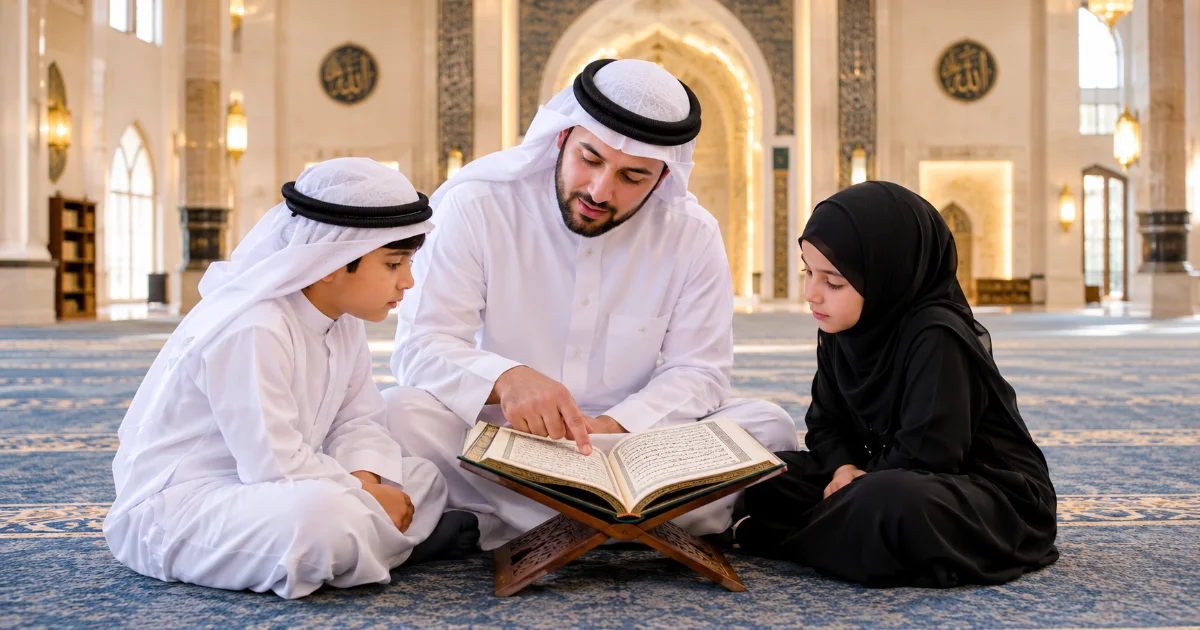



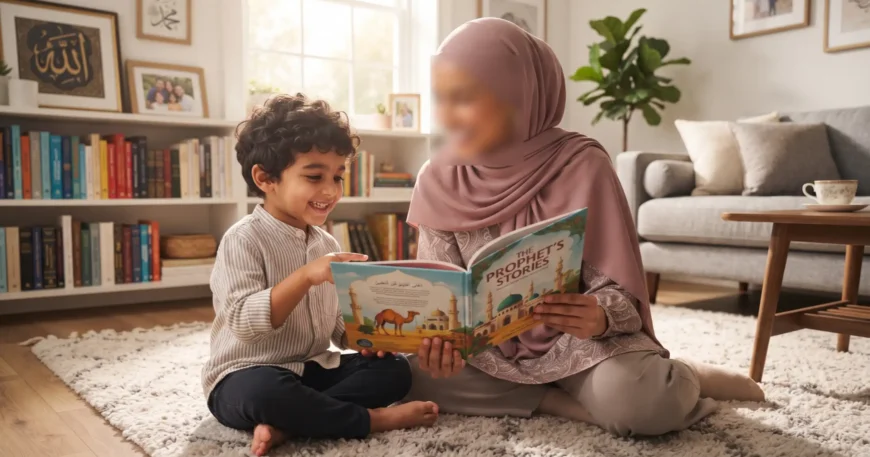
It’s 7 PM on a school night. You’ve promised your child “Islamic story time,” but the last three attempts ended the same way: a teacher who spoke too fast in broken English, a worksheet nobody understood, or a screen your child begged to run away from.
If you’re a Muslim parent in the UK, USA, Canada, Australia or the Gulf (UAE/QATAR) raising kids in a Western lifestyle, you already know the struggle isn’t a lack of love for the deen. It’s finding resources that are actually built for your child: fluent English, age-appropriate, fun, and free of the scolding-teacher stereotype so many of us grew up with.
That’s exactly why we put together this list of 12 Rabi ul Awal activities for kids, simple, screen-friendly, and rooted in real Seerah stories in English your children will actually remember. No lectures. No fear. Just Tarbiyah (character-building) done gently, the way the Our Final and Last Prophet Muhammad ﷺ himself taught children.
By the end of this guide, you’ll have a full month of low-prep, high-connection activities, plus a clear answer to why so many Western parents are quietly moving away from strict, old-school madrasah methods in favor of something warmer.
Why Rabi ul Awal Matters for Your Child’s Iman
Rabi ul Awal is the third month of the Islamic calendar, the month the Prophet Muhammad ﷺ was born, and the month he later passed away. For centuries, families across the Muslim world have used this month as a natural, low-pressure entry point into Islamic activities for kids at home, not because the reward is greater this month specifically, but because the occasion gives children a reason to ask, “Who was he?”
That single question is the doorway to everything else: Adab (manners), Sabr (patience), honesty, and kindness, all modeled through one life your child can actually picture rather than a list of abstract rules.
Many Tier 1 and Tier 2 parents also tell us this month is simply easier to build routines around. It has a clear start and end date, a built-in story, and enough cultural momentum (school breaks, community mentions, family calls back home) that kids naturally get curious without being pushed.
| Why Parents Choose Rabi ul Awal for Seerah Learning | What It Builds in Kids |
| Natural storytelling hook (a birthday, a real person) | Curiosity and emotional connection |
| Short attention-span friendly | Consistency over intensity |
| Easy to tie into daily routines | Real Tarbiyah, not memorized facts |
| Works across time zones (EST, GMT, GST) | Family bonding, not just “class time” |
| Low prep, high emotional payoff | Confidence in asking questions about faith |
12 Rabi ul Awal Activities for Kids at Home
Here are 12 easy, low-prep activities you can start tonight. No Arabic fluency or teaching background required, and every one of them can be adapted for a five-year-old or a ten-year-old.
1. Bedtime Seerah Story Corner
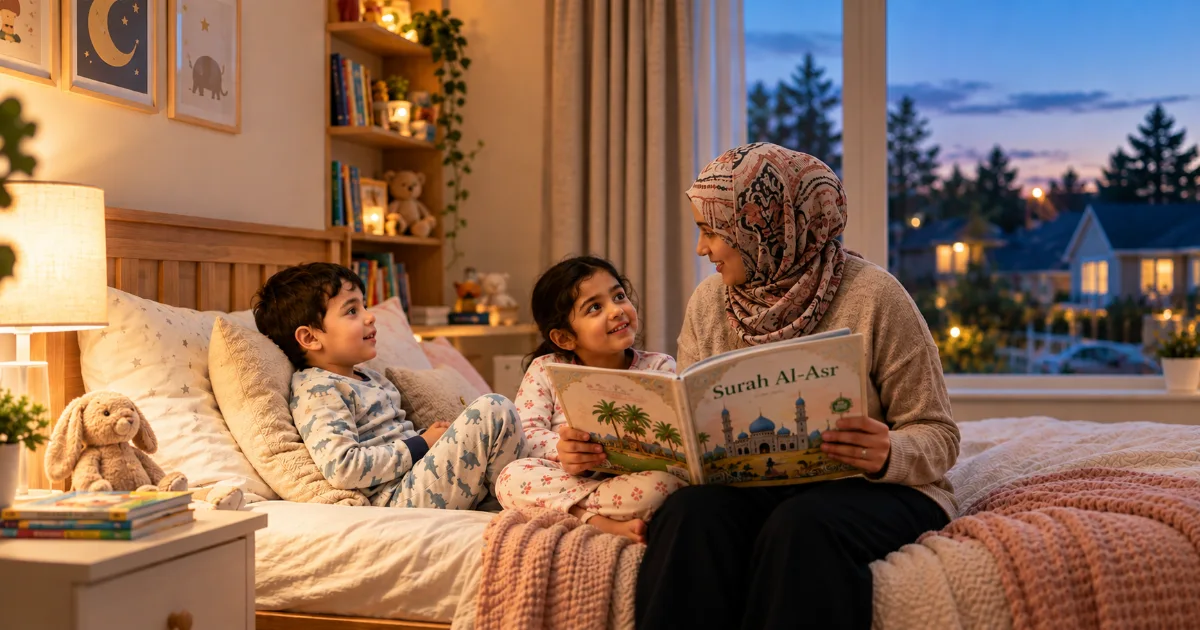
Pick one short, true moment from the Prophet’s ﷺ life each night: his honesty as a young trader, his gentleness with children, his patience during hardship. Keep it to 5 minutes. End with one simple question: “What did he do that we can do too?” This turns bedtime into a gentle nightly ritual instead of a rushed chore.
2. The Kindness Jar
Label a jar “Sunnah of Kindness.” Every time your child does something gentle, sharing, helping, smiling at someone, they drop in a bead or button. By the end of Rabi ul Awal, count them together and talk about which one felt the best to do.
3. Draw-the-Story Sessions
After telling a Seerah story, hand your child paper and crayons and ask them to draw their favorite part. This turns passive listening into active memory-building, and it works beautifully even for children who can’t read or write yet.
4. Sunnah Table Manners Night
Pick one meal this week to practice a Sunnah together: saying Bismillah, eating with the right hand, not wasting food. Make it a game, not a rule, by turning it into a friendly “Sunnah Chef” challenge at the dinner table.
5. Salawat Sing-Along
Play a gentle, child-appropriate Salawat or Nasheed during car rides or clean-up time. Repetition through melody is one of the easiest ways young children absorb Arabic phrases naturally, without any formal teaching at all.
6. Build a Mini Masjid an-Nabawi
Using cardboard, LEGO, or blocks, build a simple model of the Prophet’s ﷺ mosque in Madinah. While building, explain who helped build the real one, and why community mattered so deeply to him.
7. “What Would He Do?” Role Play
Act out simple daily situations: greeting a neighbor, sharing a toy, apologizing after a mistake, and ask your child how the Prophet ﷺ would have responded. This is one of the fastest ways to move Seerah from “story” to “habit.”
8. Seerah Comic Strip
Older kids (7+) can turn a short Seerah story into a 4 to 6 panel comic strip with captions. It’s a fun way to check comprehension without a worksheet, and most children genuinely enjoy showing off the finished comic to family.
9. Family Salawat Circle
One evening this month, sit together as a family with no screens, and send Salawat on the Prophet ﷺ collectively. Let your child lead one round if they’re ready. Even a two minute circle builds a memory that lasts years.
10. Sadaqah Box for the Month
Set up a small “Sadaqah for the Sunnah” box. Let your child contribute coins from their allowance and decide together where it goes at month’s end. This quietly teaches generosity as a lived Sunnah rather than a lecture topic.
11. Name-the-Feeling Storytelling
When telling a Seerah story, pause and ask, “How do you think he felt right then?” This builds emotional vocabulary alongside Islamic knowledge, a technique child psychology specialists often recommend for long-term retention and empathy development.
12. Rabi ul Awal Reflection Card
On the last night, ask your child to say (or draw) one thing they learned about the Prophet ﷺ this month, and one thing they want to try themselves. Keep the card. Year after year, it becomes a beautiful, growing record of your child’s relationship with their faith.
The Tarbiyah Focus: Why These Activities Matter More Than They Seem
None of these 12 activities are about memorizing dates or facts. That’s the real difference between religious information and true Tarbiyah: the gradual, gentle nurturing of character that mirrors how the Prophet Muhammad ﷺ himself raised and taught children around him.
Every activity above ties back to a core value:
- Adab (Manners): practiced through table manners night and role play, not lectured
- Sabr (Patience): modeled through Seerah stories about hardship, not forced through discipline
- Punctuality and consistency: built through small, repeatable daily habits, not one big “Islamic Studies” session
- Emotional connection: built through storytelling and reflection, not memorization drills
This is also the foundation of how to teach Seerah to kids the right way: short, emotionally resonant, and repeated, not long, dense, and one-directional. Children don’t fall in love with the Prophet ﷺ through facts alone. They fall in love with him by feeling like they genuinely know him, the same way they come to know and trust a beloved grandparent through small, repeated moments rather than a single long conversation.
Parents who keep this focus for even one month often notice something unexpected: their child starts bringing up the Prophet ﷺ unprompted, in totally unrelated moments. That’s the real sign Tarbiyah is working.
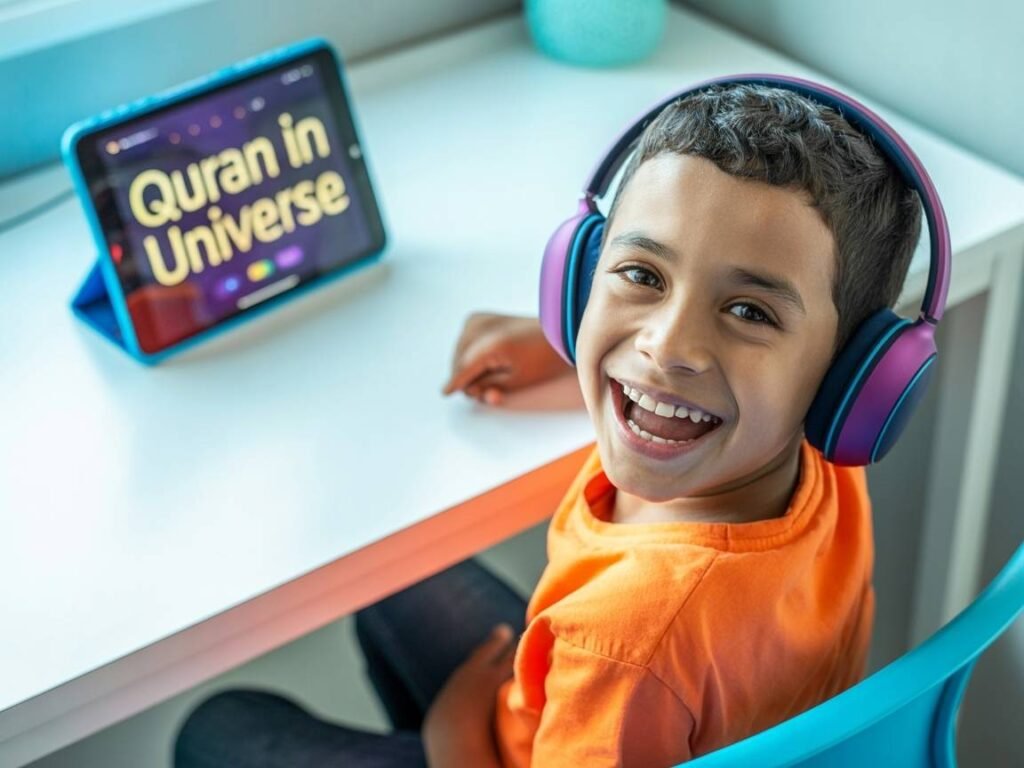
Struggling to Find English-Speaking Quran Teachers Who Actually “Get” Western Kids?
If your child enjoyed these Rabi ul Awal activities, that same warmth and patience is exactly how we teach online Quran classes for kids at Quran In Universe.
We know why so many parents hesitate before trying online Islamic education again:
- Teachers who scold instead of encourage
- Language barriers that leave kids more confused than before
- Boring, static lessons kids beg to skip
Here’s how we’re different:
| What Other Academies Offer | What Quran In Universe Offers |
| Strict, scolding teaching style | Friendly Mentor approach, patience-first |
| Inconsistent English fluency | Native-level communication, every class |
| Static screen-reading lessons | Gamified learning with interactive whiteboards |
| Unverified tutors | Background-checked, Ijazah-certified teachers |
| Male-only or mixed staff | Dedicated female teachers available |
| Limited support | 24/7 parent support and progress portal |
Every class runs on Zoom with real-time screen sharing, so your child sees, hears, and interacts rather than just listening passively. Parents get a private portal to track progress, and every teacher on our team holds a verified Ijazah, meaning your child is learning Tajweed and Seerah from someone properly qualified, not just someone who happens to speak fluent English.
This same philosophy carries into everything we teach, from Quran memorization to fun Quran learning online sessions built entirely around your child’s pace, not a rigid syllabus.
Start With a Free Trial, No Credit Card Required
You don’t have to take our word for it. Book a free trial class this Rabi ul Awal and watch how your child responds to a teacher who treats them the way the Prophet ﷺ treated children: with gentleness, patience, and genuine warmth.
Claim Your Free Trial Class Today, No Credit Card Needed
Looking for more easy Seerah stories in English, Islamic activities for kids at home, or fun Quran learning online resources? Explore more family-friendly guides on the Quran In Universe blog.
Frequently Asked Questions
What is the best age to start Seerah stories for kids?
Children as young as 3 to 4 can begin with very short, visual Seerah stories. By age 6 to 7, kids can start following slightly longer narratives and asking reflective questions on their own.
Do I need to speak Arabic to teach my child about Rabi ul Awal?
No. Every activity on this list can be done fully in English. Understanding the meaning and values behind the Seerah matters far more at a young age than Arabic fluency does.
How long should a daily Seerah activity take?
5 to 15 minutes is ideal for young children. Short, consistent sessions build stronger long-term memory and love for the Prophet ﷺ than occasional long lessons ever will.
Are these activities suitable for kids in the UK, USA, Canada, and Gulf countries?
Yes. All 12 activities are designed for Western home routines and time zones (EST, GMT, GST) and require no special classroom setup, just a home, a device if needed, and a few minutes together.
What if my child loses interest halfway through the month?
That’s completely normal. Rotate between the quieter activities (bedtime stories, reflection cards) and the more active ones (role play, crafts, comic strips) to match your child’s energy on any given day.
Related Posts