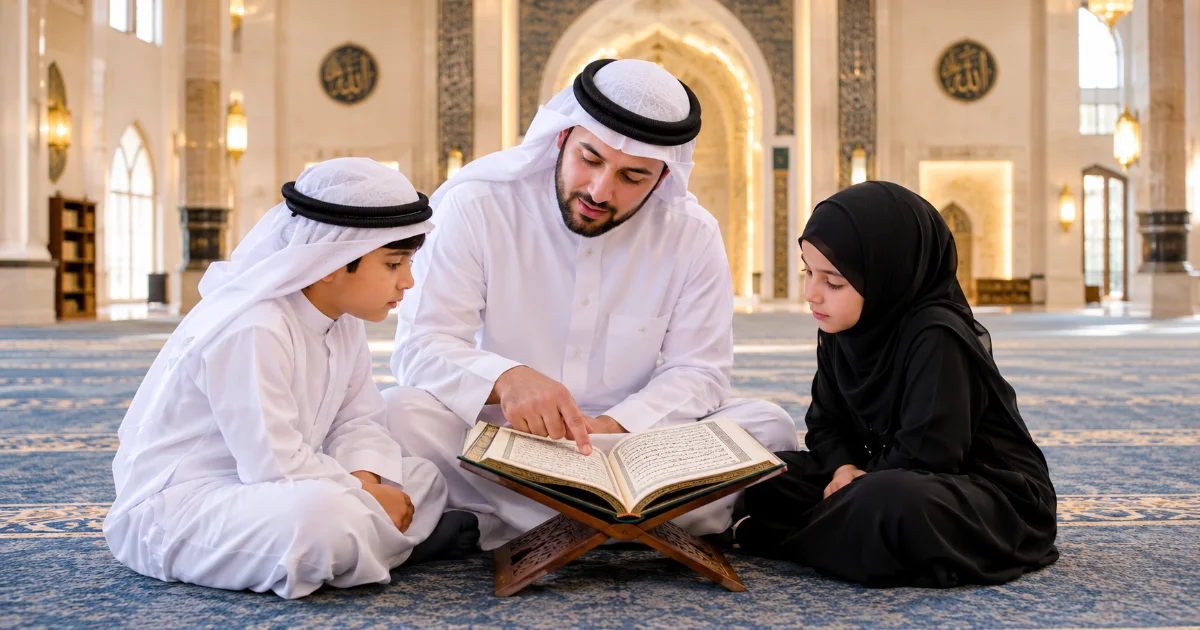




Modern life in Western metropolitan areas moves at an intense pace. Between managing career goals, keeping up with family schedules, and organizing household routines, finding a moment for deep spiritual grounding can feel difficult. For Muslim parents living in the USA, UK, Canada, and Australia, this fast lifestyle comes with an additional challenge: establishing a warm, consistent evening routine (Tarbiyah) that connects children to the beauty of the Quran without making it feel like an exhausting chore.
If you have ever felt overwhelmed trying to bring consistency to your family’s nightly devotion, you are not alone. The solution does not require hours of complex study. It lies in a simple, beautiful practice established by the Final & Last Prophet Muhammad (ﷺ): reciting and reflecting upon the last two ayats of surah al baqarah before going to sleep.
These final verses are not just lines of text; they serve as a comprehensive spiritual shield, a declaration of faith, and an emotional relief for the heart. Let us explore their text, authentic traditions, psychological memorization techniques, and practical ways to integrate them into your home tonight.
What are the Last Two Ayats of Surah Al-Baqarah? (Understanding Sura 2)
The second chapter of quran, known as al-baqarah, is the longest surah in the entire holy book. While the summary of surah al baqarah covers extensive legal rulings, historical narratives of previous nations, and core theological foundations, the final section serves as a beautiful spiritual conclusion.
When looking at how many ayat in surah baqarah, the answer is 286. Therefore, the last two ayats of surah baqarah refer specifically to quran 2:285 and quran 2:286. In classical Islamic literature, these two specific verses are widely known as Amanar Rasul or Amana Rasul because of the opening words of verse 285.
Historically, the causes of the revelation of surah baqarah last 2 ayats highlight Allah’s deep mercy toward the believers. When the preceding verse (quran 2:284) was revealed, stating that individuals would be taken to account for what is hidden within their hearts, the companions (Sahaba) felt immense fear and anxiety. They worried they could not control their passing thoughts.
The Finale & Last Prophet Muhammad (ﷺ) taught them to submit and say, “We hear and obey.” In response to their absolute compliance, Allah sent down the final two verses as a source of relief, forgiveness, and a lifelong spiritual gift.
Complete Arabic Text, Transliteration, and English Translation
To capture the Google Featured Snippet and offer a clean reading experience for mobile users, this section provides a pixel-perfect, highly scannable guide. We utilize the precise English translation of kanz-ul-irfan alongside a structured surah baqarah transliteration to support non-Arabic speakers.
Surah Al-Baqarah 285-286 Quick Reference Chart
| Arabic Script (With Clear Tajweed Spacing) | Precise English Transliteration | Simple English Meaning (Kanz-ul-Irfan) |
| اٰمَنَ الرَّسُوْلُ بِمَاۤ اُنْزِلَ اِلَیْهِ مِنْ رَّبِّهٖ وَ الْمُؤْمِنُوْنَؕ-كُلٌّ اٰمَنَ بِاللّٰهِ وَ مَلٰٓىٕكَتِهٖ وَ كُتُبِهٖ وَ رُسُلِهٖ۫-لَا نُفَرِّقُ بَیْنَ اَحَدٍ مِّنْ رُّسُلِهٖ۫-وَ قَالُوْا سَمِعْنَا وَ اَطَعْنَا غُفْرَانَكَ رَبَّنَا وَ اِلَیْكَ الْمَصِیْرُ | Amanar Rasoolu bima unzila ilaihi min rabbihi wal mu’minoon. Kullun amana billahi wa malaikatihee wa kutubihi wa rusulihi la nufarriq bayna ahadin min rusulihi. Wa qalu sami’na wa ata’na, ghufranaka rabbana wa ilayka al-masir. | The Messenger believed in that which was revealed to him from his Lord and so did the believers. All believed in Allah, and His Angels, and His Books, and His Messengers saying that we do not differentiate between any of His Messengers in believing in them. And they pronounced, “O Our Lord! We heard and obeyed, grant us Your forgiveness and to You alone is the return.” (Verse 285) |
| لَا یُكَلِّفُ اللّٰهُ نَفْسًا اِلَّا وُسْعَهَاؕ-لَهَا مَا كَسَبَتْ وَ عَلَیْهَا مَا اكْتَسَبَتْؕ-رَبَّنَا لَا تُؤَاخِذْنَاۤ اِنْ نَّسِیْنَاۤ اَوْ اَخْطَاْنَاۚ-رَبَّنَا وَ لَا تَحْمِلْ عَلَیْنَاۤ اِصْرًا كَمَا حَمَلْتَهٗ عَلَى الَّذِیْنَ مِنْ قَبْلِنَاۚ-رَبَّنَا وَ لَا تُحَمِّلْنَا مَا لَا طَاقَةَ لَنَا بِهٖۚ-وَ اعْفُ عَنَّاٙ-وَ اغْفِرْ لَنَاٙ-وَ ارْحَمْنَاٙ-اَنْتَ مَوْلٰىنَا فَانْصُرْنَا عَلَى الْقَوْمِ الْكٰفِرِیْنَ | La yukallifullahu nafsan illa wus’aha. Laha ma kasabat wa alayha ma maktasabat. Rabbana la tu’akhidhna in naseena aw akhta’na. Rabbana wala tahmil alayna isran kama hamaltahu ala alladhina min qablina. Rabbana wala tuhamilna ma la taqata lana bih. Wa ‘fu anna wa ighfir lana wa irhamna. Anta maulana fansurna ala alqawmi alkafirina. | Allah only burdens a life according to its capability. Any virtue earned by a life is for it alone and the adversity of any evil earned by a life is for it alone. “O our Lord! Do not seize us if we forget or err, O our Lord! Do not place upon us a heavy burden as you placed upon our predecessors, O our Lord! Do not place upon us a burden that we cannot bear, and pardon us, and forgive us, and have mercy on us; You are our Master, so help us against the disbelieving people.” (Verse 286) |
Authentic Hadith Explaining the Surah Baqarah Last 2 Ayats Benefits
Understanding the vast rewards tied to these lines shifts our practice from basic duty to a deeply meaningful routine. Authentic narrations outline several distinct surah baqarah last 2 ayats benefits.
1. Absolute Sufficiency Against Nighttime Evils
The most famous virtue sought by believers is recorded in the classical narration by Abu Mas’ud near the Ka’bah:
The Messenger of Allah (ﷺ) said: “Anyone who recites the two verses at the end of Surah al-Baqara at night, they would suffice for him.” (Sahih Muslim)
Scholars under the Hanafi school of thought and broader classical traditions clarify that “they would suffice him” operates on two fronts:
- Protection: It shields the reciter, their children, and their home from the harms of Shaytan, the evil eye (Nazah), bad dreams, and negative thoughts.
- Worship: If a busy professional or tired student is physically unable to stand for the voluntary night prayer (Qiyam-al-Layl), reciting these lines fulfills their minimum required nightly devotion.
2. A Heavenly Light from Beneath the Divine Throne
Unlike other parts of the Quran brought down via standard earthly pathways, these final lines possess a unique status. The companion Ali (رضي الله عنه) famously remarked:
“I did not think that any reasonable person could sleep without reciting the last verses of Sūrat al-Baqarah, and they are indeed treasures from beneath the Throne.”
Furthermore, as recorded in Sunan an-Nasa’i, an angel descended through a unique heavenly portal to declare them as “two lights” given exclusively to the Prophet Muhammad (ﷺ), the first light being Surah Al-Fatihah, and the second being the last verse surah baqarah contains.
Easy Memorization of Surah Baqarah Last 2 Ayats Method:
Many parents and adult professionals believe that to learn quran fast, they must spend hours in stressful, mechanical repetition. However, child psychology and modern cognitive science show that the human brain absorbs text far more efficiently through conceptual chunking, dividing long scripts into logical, small concepts connected to their meanings.
Instead of looking at the text as a large, intimidating block, break down the last 2 ayats surah baqarah into four simple, distinct pieces:
Concept Chunk 1: The Foundations of Belief (2:285 – Part 1)
- Arabic Focus: From “Amanar Rasoolu…” to “…min rusulihi”
- The Meaning: Confirming absolute belief in Allah, His angels, His books, and all His prophets equally.
- The Mental Map: Picture a massive, unbroken historical chain connecting all the prophets. For children, this creates a clear sense of identity and global community belonging.
Concept Chunk 2: Active Obedience & Return (2:285 – Part 2)
- Arabic Focus: From “Wa qalu sami’na…” to the end of the verse “…al-masir”
- The Meaning: “We heard and obeyed.” Asking for forgiveness and realizing that our ultimate destination is with our Creator.
- The Mental Map: Associate this chunk with clearing your mental slate. You are laying down the day’s work and submitting your affairs to the Al-Mighty.
Concept Chunk 3: The Promise of Divine Ease (2:286 – Part 1)
- Arabic Focus: From “La yukallifullahu…” down to “…maktasabat”
- The Meaning: The comforting rule that allah doesn’t burden a soul past its personal capacity, and that every individual carries their own deeds.
- The Mental Map: This serves as an immediate stress relief anchor. It reminds your mind that no matter how difficult your school exam or corporate project feels, you possess the built-in capability to manage it.
Concept Chunk 4: The Ultimate Nighttime Prayer (2:286 – Part 2)
- Arabic Focus: From “Rabbana la tu’akhidhna…” to the final word “…alkafirina”
- The Meaning: A sequence of beautiful pleas asking for mercy regarding human mistakes, relief from heavy ancestral burdens, absolute pardon, and divine assistance.
- The Mental Map: Treat this as a deep, reassuring conversation with your Master.
By moving step-by-step through these conceptual steps, you discover an easy way to memorize quran lines that stays securely in your long-term memory.
Building a Consistent Nighttime Routine in Western Households
To maximize the benefits of these verses, they should become a practical, stress-free part of your daily schedule.
For Parents: A Screen-Free Tarbiyah Routine
Children growing up in the USA, UK, Canada, or Australia face constant exposure to digital stimulation. This mental overstimulation can lead to late-night anxiety, restlessness, and bedtime friction.
Replacing screens with a soothing spiritual routine can transform their evenings:
- Dim the Lights: Sit at your child’s bedside ten minutes before sleep to signal a transition to rest.
- Recite the Lines Together: Read the last two ayats of surah al baqarah slowly and softly. Let them repeat after you or read along with the transliteration.
- Reinforce the Meaning: Emphasize the phrase “La yukallifullahu nafsan illa wus’aha”. Remind your child that whatever mistake or social pressure they experienced at school today, Allah’s mercy is far greater.
- Perform the Sunnah Action: Cup your hands, blow gently into them, and pass them over your child’s pillow and upper body to provide a comforting sense of safety and protection.
For Busy Professionals and University Students
If you are managing intense business goals, client accounts, or dense university exams, your mind can feel crowded by late evening.
- During Your Commute: Instead of checking notifications or listening to stressful news, listen to a clear, slow audio recitation of the last two lines of surah baqarah to naturally familiarize your ears with the rhythm of the words.
- A Daily Mental Reset: Use the last 3 verses of surah baqarah as a clear boundary between your working hours and your personal rest. Once you recite them, close your laptop, turn off your work notifications, and let your mind rest in divine care.
Perfect Your Pronunciation (Private Quran Learning Solution)
While using transliteration charts or reading text tables is a great way to start, the Quran is ultimately an oral tradition. Arabic relies on very precise articulation points (Makharij); making a minor mistake in how you pass air through your throat can change the beauty and clarity of a word.
To truly master your recitation and feel entirely confident teaching these lines to your children, having an experienced human ear to guide you makes a world of difference. Traditional classrooms can sometimes feel overly critical, strict, or intimidating, which can discourage busy adults and young children alike.
At Quran in Universe, we provide an entirely different approach. We function as your fluent english quran tutor, building a warm, highly encouraging, and empathetic environment. Our approach focuses on positive reinforcement, making it easy and stress-free for your entire family to learn.
Common Questions About the Surah Baqarah
Is it acceptable to read the last two ayats of Surah Al-Baqarah from a mobile phone screen?
Yes, it is entirely fine to read the Arabic text, English translation, or transliteration directly from your phone screen or a tablet. The main goal is to read the words with a present mind, proper focus, and clear intention before you go to sleep.
What are the benefits of the last two ayats of Surah Al-Baqarah for anxiety?
Living in busy urban areas can often lead to overthinking and late-night worry. Reciting these verses provides immediate comfort because the text directly states that your Creator does not give you challenges greater than your inner strength. Ending your evening with these words helps shift your focus from daily pressures to a sense of peace and divine protection.
What is the core difference between Ayat-ul-Kursi and the last 2 ayats of Surah Baqarah?
While Ayat-ul-Kursi (quran 2:255) focuses on Allah’s absolute sovereignty and majesty, the final two verses (2:285-286) emphasize human faith, individual accountability, and a direct plea for ease, forgiveness, and mercy. Both provide deep protection when read before sleep.
What if I don’t even know the Arabic alphabet?
That is completely fine. Many of our students start directly with the Noorani Qaida. A private setting means you can learn the alphabet at your own pace.
Can I listen to an audio recording of Amanar Rasul instead of reciting it?
While listening to a clear audio recording is an excellent way for beginners to learn correct pronunciation and follow the rhythm, actively reciting the words with your own tongue brings the full reward mentioned in the prophetic traditions. If you are still learning, you can start by reading along silently while listening to an audio recording.
Why is the last section of Surah Al-Baqarah sometimes called a complete Dua?
The final verse (quran 2:286) contains seven distinct, heartfelt requests. It covers everything a believer needs for spiritual well-being: asking for patience with human errors, relief from heavy life trials, absolute pardon, and divine protection. This makes it a comprehensive evening prayer that addresses both your everyday challenges and your spiritual goals.
Related Posts