


Table of Contents
As the blessed days of Dhul Hijjah approach, Muslim parents around the world begin preparing for a beautiful celebration. Homes fill with excitement, new clothes are bought, and families prepare to gather.
But alongside this joyous excitement comes a familiar sense of anxiety for many mothers and fathers. You might be wondering exactly how to explain Eid al-Adha to a child without causing them unnecessary worry.
For parents practicing gentle parenting, the story of Prophet Ibrahim (peace be upon him) and the concept of animal sacrifice can feel incredibly difficult to translate to a young mind.
We want to protect their innocence while instilling deep, lasting Islamic values. We want to teach them about our beautiful faith using love, positive reinforcement, and deep connection, rather than fear or strict demands.
This is a very common concern for families living in the USA, UK, Canada, and Australia. Living in Western countries often means children do not see the physical process of Qurbani the way they might in Muslim-majority nations.
Because they are removed from the agricultural realities of where food comes from, this distance requires us to be highly intentional with our words. A sudden explanation of sacrifice can easily shock a sensitive child.
The good news is that the story of Eid al-Adha is fundamentally a story of ultimate love, profound trust, and immense charity. By framing the narrative correctly, you can help your child understand the true beauty of this holiday.
In this we will walk you through exactly how to share these concepts safely. We will provide practical scripts, engaging activities, and psychological insights to make this Eid memorable and meaningful for your entire family.
The True Meaning of Eid al-Adha: A Story of Love, Not Just Sacrifice
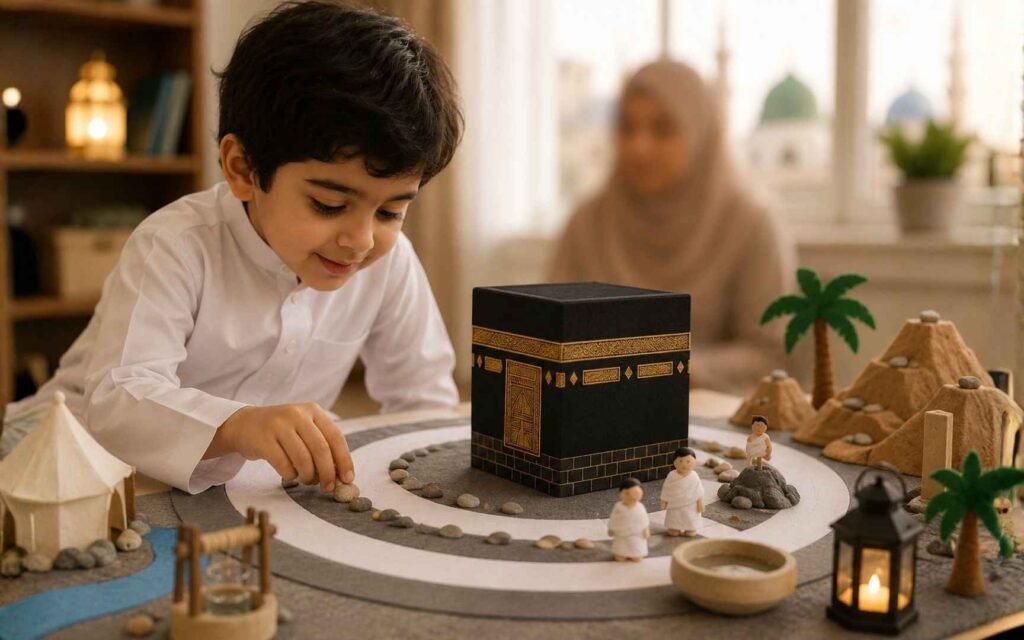
When we think about how to explain Eid al-Adha to a child, our adult minds often jump straight to the Qurbani itself. We worry immensely about how a sensitive, animal-loving child will react to the idea of an animal losing its life.
However, focusing solely on the physical sacrifice misses the broader, more beautiful picture of this holy day. Eid al-Adha is actually a celebration of Prophet Ibrahim’s absolute trust in Allah.
It is a historical story with a wonderfully happy ending, where Allah’s immense mercy replaces a difficult test with a beautiful reward. This is the positive foundation we must lay for our children.
From a psychological perspective, young children respond best to stories of rescue, love, and helping others. We can emphasize that Allah is the Most Merciful and never wanted to harm Prophet Ismail.
Instead, Allah was showing the entire world how much Prophet Ibrahim loved Him. It teaches children that Allah always protects and rewards those who trust Him completely.
This gentle approach aligns perfectly with effective and loving Tarbiyah. We are nurturing a child’s natural inclination, their Fitrah, toward love, kindness, and goodness.
By highlighting Allah’s mercy rather than the fear of the test, we build an unbreakable foundation of trust between the child and their Creator. This ensures they grow up loving their religion.
Furthermore, Eid al-Adha is heavily tied to the Hajj, the beautiful and profound pilgrimage to Makkah. Millions of Muslims gathering in peace, wearing identical simple clothing, is a powerful visual for children.
It teaches them about global unity, equality, and the vastness of the Muslim community around the world. It shows them they are part of something massive and beautiful.
Ultimately, the core practical lesson of this Eid is charity and giving. The meat from the Qurbani is specifically divided so that the poor and hungry receive a substantial portion.
When you explain that this holiday is about making sure no one in the world goes to sleep hungry, children immediately grasp the beauty of the tradition. Their natural empathy connects with the goal of feeding the poor.
Age-Appropriate Ways to Explain Eid al-Adha
Child psychology tells us that a three-year-old processes information very differently than a ten-year-old. A preschooler takes things incredibly literally and often has a deep emotional connection to animals.
An older child, however, is beginning to understand abstract concepts. They can grasp ideas like charity, obedience, historical context, and global poverty.
Therefore, our storytelling must adapt to their specific cognitive development. We absolutely cannot use a one-size-fits-all approach when discussing matters of faith with children.
Adapting your language ensures your child feels safe, heard, and understood. Below is a detailed guide on how to approach these vital conversations based on your child’s age group.
Age-Appropriate Breakdown for Parents
| Age Group | Cognitive Stage | Focus of the Story | Key Concepts to Emphasize | What to Avoid |
| Ages 3-5 | Concrete thinking, high empathy for animals, literal interpretation. | Prophet Ibrahim’s love for Allah and the big feast to feed the poor. | Sharing food, saying “Bismillah”, Allah’s love, sheep as a special gift. | Details of the sacrifice, words like “kill” or “blood”, the scary parts of the dream. |
| Ages 6-8 | Emerging logic, understands right and wrong, asks “why” often. | The test of trust, the happy ending with the ram, the importance of charity. | Trusting Allah, helping hungry families, the concept of a test, Hajj to Makkah. | Graphic details of the Qurbani process, emphasizing the fear or danger in the dream. |
| Ages 9+ | Abstract reasoning, understands complex morals and history. | The historical context of the test, ultimate submission to Allah’s will. | Prophet Ismail’s bravery, historical legacy, dividing the meat into thirds, deep Tarbiyah. | Forcing the conversation if they feel uneasy; allow them to ask the hard questions openly. |
When applying gentle Islamic parenting tips USA, UK, or anywhere else globally, remember that this table is just a starting point. You know your individual child best.
If your seven-year-old is highly sensitive, simply stick to the guidelines meant for younger children until they are ready. There is no rush in Islamic education; patience is key.
Gentle Scripts: Talking About Qurbani Safely
One of the biggest hurdles well-meaning parents face is finding the right words in the heat of the moment. When a child suddenly asks a tough question, our reaction sets the tone for their understanding.
When a child asks, “Why do we have to hurt the sheep?”, freezing up or giving a harsh, strictly dogmatic answer can cause lasting anxiety and confusion.
Having a prepared script in your mind helps you stay completely calm. It allows you to deliver a message rooted in love, patience, and positive reinforcement.
Here are a few practical, conversational examples you can use to start explaining Qurbani to preschoolers safely, as well as older children.
Script 1: For the Preschooler (Focus on Sharing)
Child: “Why did the sheep have to go away?”
Parent: “Allah made amazing animals to help us stay strong and healthy, just like the yummy chicken we eat for dinner. On Eid, we get a special sheep so we can have a giant, happy feast. But the absolute best part is, we share a lot of it with people who don’t have enough food. Allah loves it when we share with hungry people!”
Script 2: For the Early Elementary Child (Focus on the Test)
Child: “Did Allah really want Prophet Ibrahim to sacrifice his son? That’s scary.”
Parent: “I know it sounds scary at first, but no, Allah never wanted Prophet Ismail to be hurt! Allah is the Most Merciful. It was a test to see if Prophet Ibrahim loved Allah the most. As soon as he showed he was willing to listen, Allah replaced Ismail with a beautiful, fluffy ram from heaven. It’s a story with a very happy ending!”
Script 3: For the Older Child (Focus on Charity and Duty)
Child: “It still makes me sad for the animals. Why do we have to do it every year?”
Parent: “It’s completely normal to feel empathy; that shows you have a beautiful, kind heart. In Islam, we treat animals with the utmost respect. When an animal provides food for us, it is fulfilling a noble purpose. We do Qurbani to ensure that on this special day, millions of poor families around the world get to eat fresh meat, something they rarely get to do. It is about immense charity and making sure nobody goes hungry.”
By using these specific scripts, you actively validate their feelings. You are not shutting down their curiosity, but rather directing it toward the highly positive outcomes of the holiday.
Engaging Eid al-Adha Activities for Kids at Home
Children learn best through active, joyful play. Sitting them down for a long, dry lecture about the history of Dhul Hijjah will likely result in them quickly tuning out.
Instead, creating hands-on experiences helps them internalize the joy and significance of the holiday. They remember how the holiday made them feel long after the day has passed.
Planning fun eid al adha activities for kids at home is absolutely crucial, especially in Western countries. Because the festive street atmosphere isn’t naturally present outside, you have to create the joy inside your own home.
Here are four highly engaging, practical, and child-friendly activities to try with your family this season.
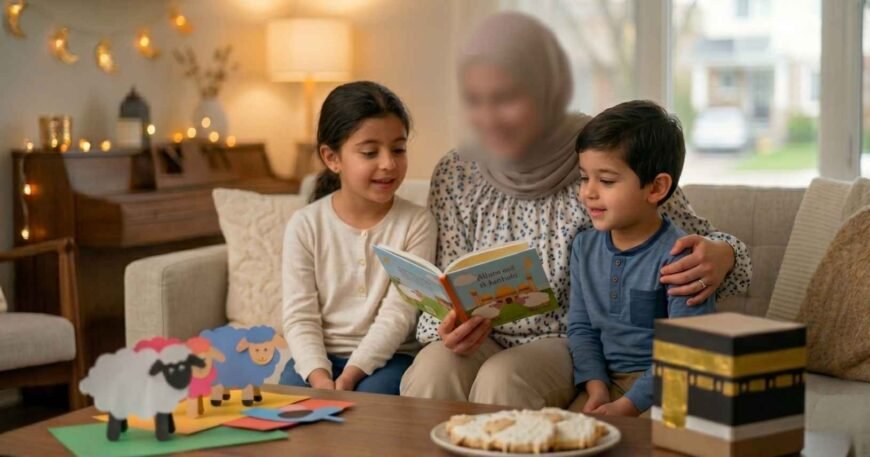
1. Build a Cardboard Kaaba
Connecting Eid al-Adha to the Hajj pilgrimage is a fantastic way to broaden their understanding of the holiday. Save some large delivery boxes leading up to Eid and let your children paint them black.
Once dry, use yellow tape or gold paint to create the beautiful script on the Kiswah (the cloth covering the Kaaba). You can teach them the Talbiyah (“Labbayk Allahumma Labbayk”) while they walk around their beautiful creation in the living room.
2. The “Share the Meat” Sorting Game
For younger children, you can easily create a sensory bin or a sorting game to explain the division of Qurbani. Cut out pictures of food or use play dough to represent the meals.
Set up three distinct baskets: one for your family, one for relatives/friends, and one for those in need. Have your child divide the items equally into the baskets, reinforcing the Islamic rule of thirds in a tangible, incredibly fun way.
3. Bake Sheep-Shaped Cookies
Baking is a wonderful family bonding activity that naturally allows for relaxed conversation. Buy a sheep-shaped cookie cutter online and spend an afternoon baking and decorating cookies together.
While rolling out the sweet dough, gently discuss the story of the beautiful ram sent from heaven. When the cookies are done and cooled, package some up nicely to give to your neighbors, actively practicing the Sunnah of sharing and neighborly love.
4. Create a “Good Deeds” Tree for Dhul Hijjah
The first ten days of Dhul Hijjah are incredibly special and hold massive rewards. Draw a large, simple tree trunk on a poster board and cut out plenty of green paper leaves.
Every time your child does a good deed, like sharing a beloved toy, helping clear the dinner table, or saying something exceptionally kind, they get to stick a leaf on the tree. This provides constant, visible positive reinforcement throughout the holy days.
The Role of Gentle Education in Islamic Tarbiyah
As parents, we dedicate ourselves to doing our absolute best to teach our children at home. We read the bedtime stories, do the messy crafts, and try patiently to answer their endless questions.
But there often comes a point where we realize we need outside support to deepen their Islamic education. We want them to learn how to read the Quran properly, but we want the experience to be joyous.
Many parents in Tier 1 countries struggle significantly to find local classes that align perfectly with their modern, gentle parenting philosophy. We desperately want our children to love the Quran, not fear their teachers.
When looking for a child friendly online quran teacher UK or USA, you need someone who deeply understands child psychology. You need an educator who knows how to inspire rather than intimidate.
You need a mentor who speaks their primary language perfectly and knows exactly how to keep them engaged without ever resorting to harshness or strict discipline that pushes them away from the Deen.
Discover Child-Friendly Learning with “Quran in Universe”
At Quran in Universe, we completely understand the valid concerns modern Muslim parents face today. We know that you want your children to learn the Book of Allah in an environment filled with pure joy, infinite patience, and constant encouragement.
We are incredibly proud to offer highly customized One-on-One Experiences Online Quran Classes that move entirely at your child’s unique pace. We do not believe in rushing, comparing, or pressuring young minds.
Instead, our unique platform connects your family with Friendly Mentors who are genuinely passionate about teaching children. We focus on building confidence alongside Islamic knowledge.
Communication is the vital key to successful learning, especially for children living in the West. That is why our mentors possess Native-Level or highly fluent English skills.
Your child will never struggle to understand their teacher. This clear communication allows them to build a strong, trusting, and friendly bond from the very first introductory lesson.
Furthermore, we utilize modern Gamified Learning to make studying the Quran genuinely exciting for the digital generation.
- Interactive Whiteboard: Children actively participate in tracing Arabic letters, drawing, and interacting with the lesson material directly on the screen.
- Reward Systems: We use digital stars, positive verbal reinforcement, and fun educational games to ensure they earn rewards, making every session something they eagerly look forward to.
- Customized Pacing: If a child is having a slow day, our mentors gently adapt the lesson to keep it stress-free and enjoyable.
Safety and your peace of mind are our absolute top priorities. We know inviting a teacher into your home, even virtually, requires immense trust.
Every single tutor on the Quran in Universe platform is 100% background-checked and thoroughly vetted for their character and teaching style. You can rest easy knowing your child is learning in a highly secure, supportive, and completely professional virtual environment.
Whether you are searching for fun online quran classes for children in Canada, Australia, the USA, or the UK, we easily adapt to your specific time zone and busy family schedule. We handle the educational side with deep love and expertise, so you can focus on simply enjoying beautiful moments with your family.
Make This Eid the Start of a Beautiful Journey
Explaining Eid al-Adha to a child doesn’t have to be a stressful or anxiety-inducing experience. It is a beautiful opportunity to bond over the core values of our faith.
By focusing heavily on Allah’s endless mercy, the incredible beauty of charity, and the power of giving to others, you can turn a seemingly complicated topic into a beloved, joyful family tradition.
Use the conversational scripts and hands-on activities provided in this guide, and always remember to meet your child exactly where they are developmentally. Patience and love are your best parenting tools.
If you are looking for a highly supportive, gentle environment to continue your child’s Islamic education long after Eid is over, we are here to help you succeed. At Quran in Universe, we turn learning the Quran into a beautiful adventure.
Give your child the incredible gift of a friendly mentor and a lifelong, unbreakable love for the Quran.
Schedule Your One-on-One Session Today and see the massive difference a gentle, modern approach can make in your child’s life. Book a Free Trial with Quran in Universe now!
Frequently Asked Questions (FAQs)
At what age should I tell my child the full story of Qurbani?
You can safely introduce the full historical context around age 8 or 9, depending on their maturity level. Before that age, keep the focus strictly on Allah’s mercy, the happy ending with the ram, and sharing delicious food with hungry people.
How can I make Eid al-Adha fun in a non-Muslim country?
Create immense excitement at home by decorating the house, dressing up in beautiful new clothes, and doing hands-on crafts like building a cardboard Kaaba. Involving them in baking treats for neighbors also quickly builds a festive, highly joyful atmosphere.
What if my child gets upset about the animals being sacrificed?
Validate their feelings immediately by telling them it is wonderful to have a kind heart. Explain clearly that Muslims treat animals with deep respect, and the sacrifice is specifically meant to provide a rare, highly nutritious meal for very poor families around the world.
What should I say if my child asks, “Will Allah ask you to sacrifice me?”
Reassure them instantly with a warm smile and say, “No, absolutely not!” Explain that Prophet Ibrahim’s test was a very unique, historical event. Remind them that Allah is the Most Merciful, loves them immensely, and only wants us to stay safe and do good deeds.
How is Hajj connected to Eid al-Adha for kids?
Explain that Eid al-Adha is a massive global celebration marking the end of Hajj, the beautiful pilgrimage to Makkah. While millions of Muslims worship together there, Muslims all over the world join in their joy by praying, celebrating, and sharing food.
Related Posts